
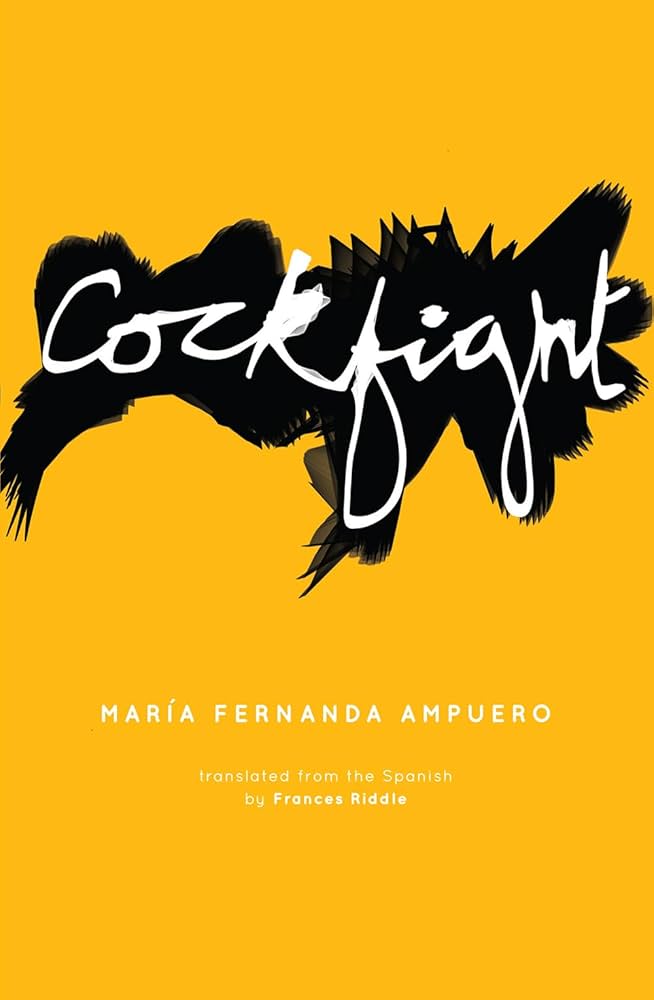
Behind the intimacy of the home lies abuse, silence, and violent relationships that no one wants to see. Cockfight constructs a disturbing mosaic of stories where horror emerges from the everyday and the real monsters live within the family. The story collection that turned María Fernanda Ampuero into one of the most celebrated voices in contemporary Latin American literature.
María Fernanda Ampuero, one of the most powerful voices in contemporary Latin American literature, constructs in Cockfight a set of intense and disturbing stories where violence infiltrates the most intimate space: the family. Her writing is direct, physical, almost visceral, and works with a very particular kind of horror: an everyday terror that arises not from the supernatural but from what happens inside homes, in family relationships, in the silences and abuses that sustain domestic life.
Each story unfolds like a tension-filled scene, with a perspective that blends childhood innocence, memory, and the horror of the everyday. Houses—working-class homes, wealthy families, silent apartments, or seemingly quiet towns—function as closed settings where secrets, abuse, and invisible hierarchies pulse beneath the surface. From these homes, different narrative voices—young girls, teenagers, adult women, or peripheral witnesses—reveal how affection, fear, and violence coexist in domestic life.
With books like Cockfight, Ampuero has established herself as one of the authors redefining contemporary Latin American literature, alongside writers such as Mariana Enriquez, Mónica Ojeda, Agustina Bazterrica, or Samanta Schweblin.
In Auction, a kidnapped woman is exhibited in a clandestine human auction. While buyers inspect the victims as merchandise, she remembers her childhood in a cockfighting ring with her father, where she learned that sometimes the only way to survive is to become undesirable. Using that lesson, she deliberately degrades herself before the buyers until they consider her useless and abandon her on a roadside.
In Monsters, two sisters live fascinated by horror films and believe that real dangers belong to the world of the dead. But one night they discover that horror inhabits their own home when they catch their father in the garage with the young domestic worker. The next day, the girl has disappeared and the sisters understand that real monsters do not come from movies.
Griselda follows the memory of a neighborhood boy who idolizes a neighbor famous for the extraordinary birthday cakes she prepares for all the children. Through his innocent gaze, the tensions of that woman’s life and the rumors surrounding her daughter are gradually revealed. The story culminates brutally when, one Christmas night, the daughter shoots her own mother.
In Nam, a teenager spends the night at the house of her new friend Diana, toward whom she feels an intense and confusing attraction. During that visit, she discovers the secret that defines the family: Diana’s father, a Vietnam War veteran, lives hidden in a room, physically and mentally devastated by the conflict. The accidental encounter with that man—reduced almost to a feral creature—marks the memory of that friendship forever.
In Offspring, an adult woman returns to the neighborhood of her childhood and decides to visit the neighbor who initiated her sexually when she was twelve. The reunion reveals an aged, isolated man obsessed with the violence of nature. Among images of animals devouring their own young, the protagonist confronts a past where desire, power, and abuse became dangerously intertwined.
In Blinds, Felipe spends summers in a house marked by illness, absence, and abandonment. Over time, loneliness and emotional dependency distort family bonds and push the protagonist toward an increasingly unsettling relationship with his mother.
Christ tells the story of a girl who tries to care for her severely ill baby brother while her mother desperately searches for a religious miracle. When the child dies, the girl is left trapped between guilt, incomprehension, and the weight of a faith that cannot explain tragedy.
In Passion, Ampuero reimagines Mary Magdalene as a woman marked by violence since childhood. After meeting Jesus, she becomes his closest follower and, after his execution, carries out an extreme act driven by love, faith, and desperation.
In Mourning, two sisters celebrate with a banquet the death of the brother who abused them for years. Throughout the dinner, it is revealed that one of them had been slowly torturing him during his illness, while the unexpected arrival of a visitor suggests that the cycle of violence has not yet ended.
Ali reconstructs the life of the daughter of a wealthy family through the voices of several domestic workers who worked in the house. Among their memories appears the image of a girl who lived terrified of her own father and who, after years of isolation and fear, ends up sinking into a spiral of psychological deterioration that culminates in her suicide.
In Chorus, a group of upper-class women gathers to drink and talk. Between gossip and laughter, the night drifts into collective cruelty when they decide to invade the domestic worker’s room and mock her belongings. The game becomes increasingly aggressive until it leads to tragedy.
In Chlorine, a mature woman spends the night alone in the suite of a luxury hotel. From the balcony, she watches workers clean the pool while reflecting on the passage of time, her own body, and the feeling of isolation within a world built on appearances.
Finally, Another follows a woman doing the monthly shopping while thinking only of the tastes of her violent husband. At the supermarket checkout, she makes a seemingly minimal but deeply significant decision: to separate herself from that cart full of products that do not belong to her and begin to imagine another possible life.
Taken together, the stories in Cockfight construct a mosaic of lives shaped by intimate violence, social inequality, and the need to survive. Each story opens a different door into that domestic universe where fear, desire, power, and resistance coexist under the same roof.
RELEVANT INFORMATION: María Fernanda Ampuero is an Ecuadorian writer and journalist who has collaborated with numerous international media outlets. She has won the Mary Shelley Award, the Cosecha Eñe Prize, and the Joaquín Gallegos Lara Prize, awarded by the Municipality of Quito.
Her work Cockfight was listed among the ten best fiction books of 2018 in a list published in The New York Times. This short story collection has strong audiovisual potential because it presents brief, intense, and highly visual stories centered on clear characters and high-tension situations: abuse, power, fear, and small acts of rebellion.
Its structure makes possible both a series—where each episode explores a different story—and an ensemble project connected by the same universe: the home as the place where true monsters are born.
The work and the author have received excellent critical acclaim:
“Brutal!” — Mariana Enriquez.
“María Fernanda Ampuero’s voice is harsh and beautiful; her stories are precious and dangerous objects.” — Yuri Herrera.
“With Cockfight, María Fernanda Ampuero established herself as one of the most outstanding short story writers in Latin America.” — Cultura Nexos.
“Cockfight is one of the flagship titles of the publisher Páginas de Espuma.” — El Telégrafo.
AUDIOVISUAL POTENTIAL: TV Series, Miniseries, Film, TV Film.
AVAILABLE LANGUAGES: Spanish, English, Portuguese, and Greek.
Adquirir los derechos
Para ponerte en contacto con nosotros completa el siguiente formulario y te responderemos en breve.
